
The Texas Rangers, a roving posse of expert gunmen, were not men to be messed with. Following their adversaries everywhere, they lived out of the saddle and often dispensed justice brutally. Two of these men were Creed Taylor and William Alexander Anderson “Big Foot” Wallace, who was himself a folk hero. It was Big Foot, with Creed’s blessing, who unwittingly created El Muerto.
In 1850, a man known simply as Vidal was busy rustling cattle all over South Texas, and soon he had a high price on his head – “dead or alive.” During that summer, Vidal took advantage of a Comanche raid, which pulled most of the men northward to fight off the attack. In the meantime, the sparse settlements were temporarily left unguarded. Vidal, along with three of his henchmen, wasted no time taking advantage of the situation and gathered up many horses on the San Antonio River, heading southwest toward Mexico.
Vidal didn’t know that among the stolen herd were several prized mustangs belonging to Texas Ranger Creed Taylor, usually one of the first to defend the settlements against Indian attacks, who had not, on this occasion, gone after the Comanche. Creed’s ranch lay west of San Antonio, in the thickest of bandit territory, not far from the headwaters of the Nueces River. Due to the ranch’s location, Taylor’s livestock and horses were frequently targeted by the numerous bandits.
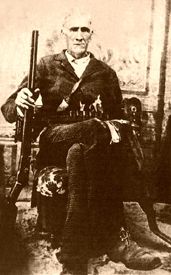
Bigfoot Wallace.
Taylor had had enough and quickly gathered fellow ranger Big Foot Wallace and a nearby rancher named Flores. Wallace and Taylor were as skilled as any Comanche when tracking, and the three men found Vidal’s and his henchmen’s trail.
When the three men found the outlaw camp, they waited to attack until night, when the bandits were sleeping. Catching them unaware, the thieves were killed. But just killing them was not enough. Taylor and Wallace wanted to set an example that would deter future bandits. In those days, stealing cattle and horses was a crime more serious than murder. The Rangers had tried all types of brutal justice, including stringing them up in trees and leaving them hanging, shooting them, chopping them to pieces, and leaving their bodies for animal bait. But nothing had worked to stop the outlaws.
In a dramatic example of frontier justice, Wallace beheaded Vidal and then lashed him firmly into a saddle on the back of a wild Mustang. Tying the outlaw’s hands to the pommel and securing the torso to hold him upright, Big Foot then attached Vidal’s head and sombrero to the saddle with a long strip of rawhide. He then turned the bucking horse loose to wander the Texas hills with its terrible burden on its back.
Soon, stories began to abound about the headless rider usually seen in a remote country, with its sombreroed head swinging back and forth to the rhythm of the horse’s gallop.
As time went on, more and more cowboys spotted the dark horse with its fearsome cargo, and not knowing what it was, they riddled it with bullets. But the horse and its rider rode on, and the legend of El Muerto, the headless one, began. Soon, the South Texas brush country became a place to avoid as El Muerto was credited with all kinds of evil and misfortune.
The Texas Headless Horseman is a folktale known as El Muerto, the story of a headless bandit, Vidal, who was tied to a horse and left to roam the South Texas plains after being killed by Texas Rangers led by Creed Taylor. Legend says his ghost, or the corpse on the horse, is still seen riding through the region, sometimes accompanied by the sounds of thunderous hooves. The legend claims crossing his path brings misfortune.
- Origin: The legend stems from the mid-1800s after a Mexican bandit named Vidal stole horses from Texas Ranger Creed Taylor.
- The Execution: Taylor and his men caught Vidal and, as punishment, decapitated him, strapped his body upright onto his horse, and secured his head to the saddle horn.
- The Legend’s Spreading: The horse, with its headless rider, escaped and began to gallop through the area. Other riders and ranchers reported seeing the terrifying sight and began to call it El Muerto, or “the dead one”.
- The Aftermath: A posse eventually captured the horse, finding the corpse riddled with bullets and arrows. They buried the body in an unmarked grave, but the legend persisted, with sightings continuing for years.
- Literary and Cultural Impact: The story has inspired other works, including Mayne Reid’s novel,The Headless Horseman: A Strange Tale of Texas.
- Connection to Sleepy Hollow: The Texas legend of El Muerto is often compared to the more widely known “Legend of Sleepy Hollow” and is considered by some to be an inspiration for the later story.
The “man from the snowy Rio Grande river and Devil’s River” is likely a misremembered reference to Victor Valdez, a beloved singer from the Mexican town of Boquillas, located across from Big Bend National Park. He was known for singing “Cielito Lindo” to tourists who arrived by boat on the Rio Grande river and was sometimes called the “Singing Man of Boquillas”. There is no prominent Spanish-language song or well-known legend about a “man from the snowy Rio Grande river and Devil’s River” that combines these two locations.
Victor Valdez: A popular singer from Boquillas, Mexico, known as the “Singing Man of Boquillas”.
Rio Grande: Valdez sang to tourists as they rowed across the Rio Grande near Big Bend National Park.
Devils River: There is no known connection between the “Devils River” and the “man from the Rio Grande”.
@highlight David Michael Ramsey @surfman374
The phrase “the man from the snowy Rio Grande river and Devils river Spanish” does not refer to a single, specific individual in history or legend based on the search results. Instead, it seems to be a poetic or descriptive phrase that alludes to the various people and historical events associated with these significant Texas rivers
.
Here are the key historical associations with these rivers:
- Spanish Explorers and the Naming of the Rivers: Spanish explorers were the first Europeans in the area. Gaspar Castaño de Sosa traveled along the river in 1590, calling it “Laxas” (slack or feeble). Later, Texas Ranger Captain John Coffee (Jack) Hays is famously reported to have renamed the river when he reached a rugged canyon in the 1840s, stating it looked more like the “Devil’s river” than the previously used “San Pedro” (Saint Peter).
- “The Robin Hood of the Rio Grande”: Juan Cortina, a Mexican rancher and bandit, became a folk hero in the mid-1800s, known as “The Robin Hood of the Rio Grande,” for leading attacks to defend Tejano rights against Anglo settlers.
- “El Muerto” (The Headless Horseman): A local legend along the Rio Grande tells of a headless outlaw named Vidal from the early 1800s, whose body was tied to a horse by Texas Rangers as a warning to other outlaws. The “headless bandit” is a figure of local folklore.
- Early Inhabitants and Surveyors: Prehistoric people lived in caves along the Devils River as early as 11,000 years ago. Geologist Robert T. Hillled a significant expedition in 1899 to survey the canyons of the Rio Grande, a place he described as “the longest and least known”.
The phrase you are using likely evokes the rugged, wild history of the region and the diverse people—from Spanish explorers to outlaws and pioneers—who traveled through it.
 I’m The 374th Surfman USCG